Work / Noize · 2026
Prodesk
Ten products a business can buy separately, running on one account and one bill, with an AI strategist that can operate any of them on the brand’s behalf, and never acts without a click.
The problem
A small business runs on a dozen disconnected tools. The logo lives in one place, the team list in another, the email signatures in a third, and the short link on the shopfront window points wherever someone set it in 2023. Every tool asks for the same facts again, and none of them agree.
Prodesk’s bet is that those facts should be recorded once (brand, people, services, company details) and that every tool a business uses should read from that record rather than re-collect it.
Ten products, one account
Each tool is its own product with its own name and its own website: the brand dashboard, review capture, short links and QR codes, quotes and payments, email signatures, the logo studio and more. A customer can buy any one of them on its own. Underneath, they are a single system: one customer record, one login, one bill.
That is where the economics come from. Everything the products have in common (the design, the sign-in, the billing, the customer data) is built once and maintained once, so launching an eleventh product is a matter of weeks rather than months, and changing how billing works is one change instead of ten.
To the customer it simply feels joined up. You sign in once and move between tools without being asked again, even though each one lives on its own domain.
The dashboard
The dashboard is where a brand starts: everything the business has switched on, everything it could turn on, and one search box that reaches all of it. Tools open in place or in their own window, and the session follows you either way.
Everything on screen keeps itself current. A teammate accepting an invite or a payment clearing shows up without a refresh, including after a laptop wakes from sleep or the wifi drops and comes back, which is the case most software quietly gets wrong.
Agencies can put their own brand on the whole suite. A client invited by an agency sees that agency’s colours from the first frame, rather than the default theme appearing and then correcting itself.
An assistant that does the work
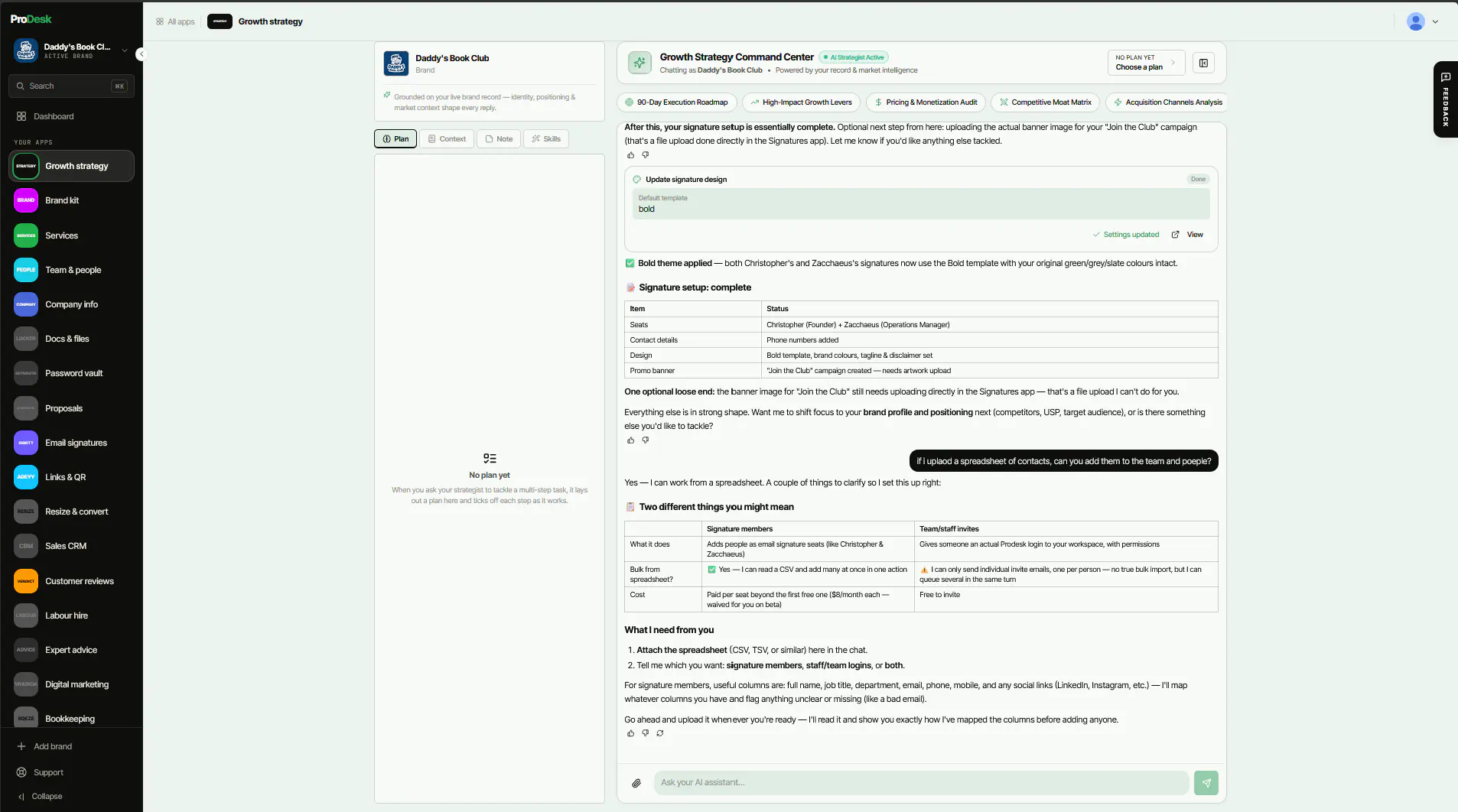
Each brand gets an AI strategist that knows that specific business (its positioning, its team, its projects, its invoices) and can operate the rest of the suite on its behalf: set up a review location, create a short link or a scheduled campaign, restyle a QR code, add email signatures for the whole team from a spreadsheet, update the public directory listing, invite someone, raise a support ticket.
The distinction that matters is that it performs the admin rather than explaining it. Something that would normally take twenty minutes of clicking across four tools takes a sentence.
Longer jobs stay visible. Multi-step work goes into a checklist the assistant works through and ticks off as it goes, so a setup that runs across several exchanges stays legible instead of disappearing into a chat log.
Nothing happens without a click
The assistant cannot change anything on its own. Every action it proposes arrives as a card you can edit and then confirm, and confirming it is what actually runs it, through exactly the same permission checks as clicking the button yourself. Anything that costs money shows the live price and the card on file before you approve it.
That constraint is the product decision, not a limitation of it. A business will not hand an AI its invoicing and its customer list unless the worst case is a card it declines.
Each brand’s data is walled off at the point the assistant is created, so there is no way for it to reach another brand’s information even if asked to. Cost per conversation is tracked and attributed per brand.
Consolidation
Four of these products existed separately first, each with its own login, its own billing and its own copy of the customer. Merging them meant moving live accounts onto the new platform without anyone losing data or a day of service, and built so the migration could be run, verified and safely re-run rather than gambled on a single cutover.
Payouts go out on two rails so the platform can pay people in countries the main processor does not cover, and money is handled in exact figures end to end, which matters more than it sounds when invoicing is the product.
What it came to
- 10+ products
- One login, one bill, one customer record
- Confirm-first
- The assistant proposes; nothing happens until you click
- White-label
- Agencies run the whole suite as their own
- 2 rails
- Payouts reach countries Stripe does not
- TypeScript
- React
- tRPC
- Drizzle
- PostgreSQL
- Supabase
- BullMQ
- Redis
- Stripe
- Wise
- Claude API
- Railway
Open to senior engineering roles
Tell me what you are building.
Full-time roles, contract work, or a system that needs someone to own it. I read everything and reply within a few hours.