Work / Noize · 2026
Verdiict
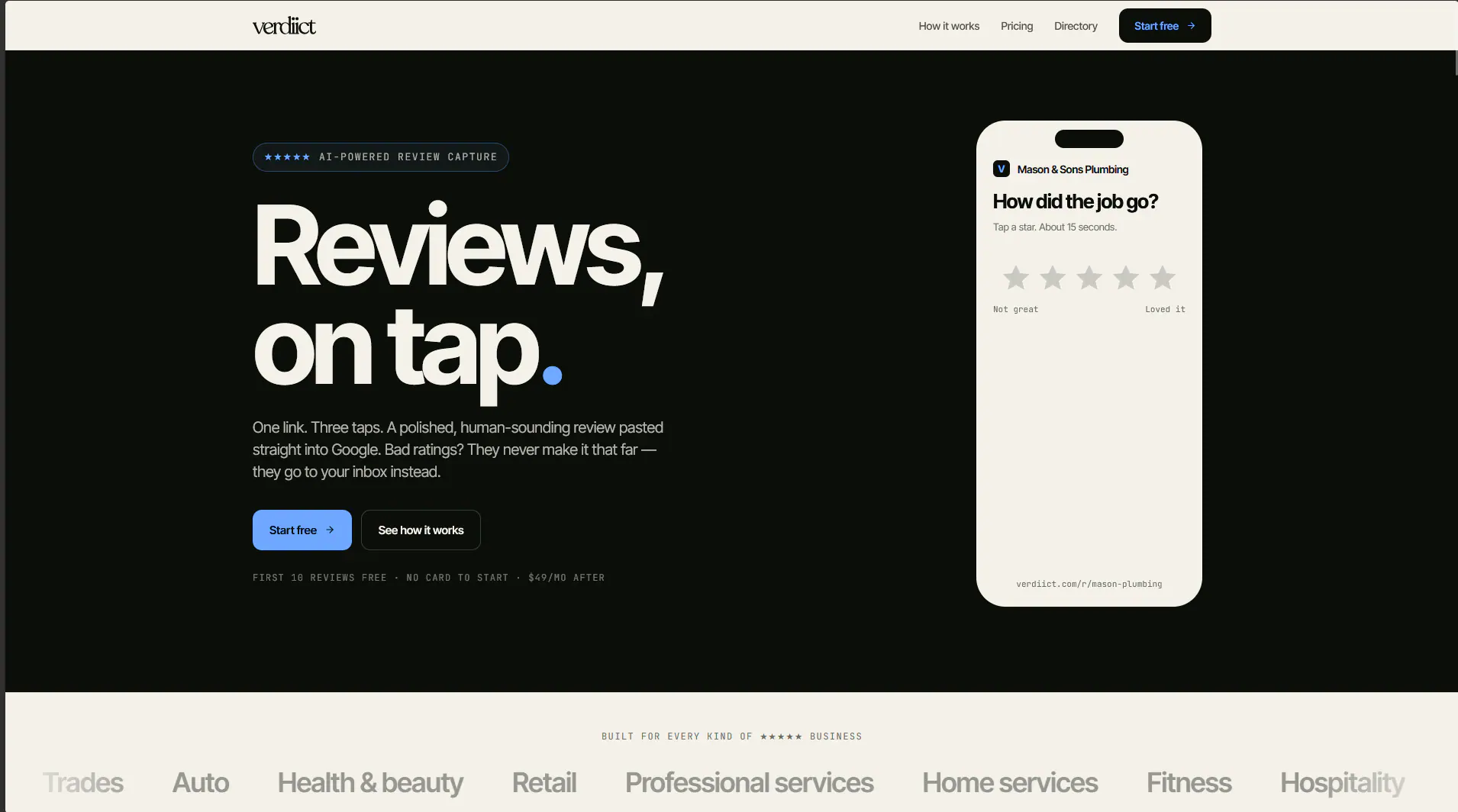
One link, three taps. Happy customers land on Google with a polished review already written; unhappy ones land in the owner’s inbox instead.
The problem
Small trade and service businesses live and die by their Google rating, and almost none of them ask for reviews, because asking is awkward, and because the customers most likely to write one unprompted are the angry ones.
What I built
A single short link per business. The customer taps a star, and that rating silently forks the journey: four and five stars continue to a generated review they can edit and paste straight into Google; one to three stars become a private message to the owner with a chance to fix it.
The generated text is the difference between a 2% and a 30% completion rate. It reads like a person wrote it (specific to the job, varied in phrasing, never templated) and it is pre-copied to the clipboard before the customer reaches Google.
The whole capture flow is built to survive a bad phone on bad reception in a customer’s driveway: no login, no app, sub-second first paint, and it works if JavaScript is slow to arrive.
Design decisions
The star row is the entire first screen. No form fields, no explanation: the interaction has to be legible in the second and a half of attention a tradesperson gets after handing over an invoice.
Owner-side, the product is a directory and a dashboard rather than an analytics tool. The only numbers that matter are reviews captured, reviews published, and complaints intercepted.
What it came to
- ~15s
- From tap to published review
- 3 taps
- The entire customer journey
- Zero-login
- No app, no account for reviewers
- TypeScript
- React
- Firebase
- LLM generation
- Google Business Profile
Open to senior engineering roles
Tell me what you are building.
Full-time roles, contract work, or a system that needs someone to own it. I read everything and reply within a few hours.